
Review: The Long Run
Martin Dugard on the decade that made the marathon cool

It seems notable that of two recent running milestones, breaking the 2-hour barrier in the marathon barely registered a ripple in the popular imagination. In fact, the moment was superseded by Rachel Entrekin besting an elite field of men, as well as women, en route to winning the Cocodona 250 outright.
Entrekin’s overall victory at Cocodona distinguished itself as a triumph of the spirit. Not only did she blast through outdated gender perceptions, she did so with infectious joie de vivre and a belief in herself that was both aspirational and highly relatable. As Entrekin put it after the race: “Why not, you know, try?”
For all its athletic and tactical brilliance, breaking the 2-hour barrier represented little more than a very expensive lab race between two sneaker industry superpowers. In an environment where records are constantly broken thanks to rapid advances in shoe technology, training science, and what we’ll gently refer to as recovery protocols, running a sub 2-hour marathon seemed oddly inevitable. Indeed, it happened twice in the same race.
Entrekin’s win at Cocodona, meanwhile, feels like a moment that will stand the test of time. Years from now, when women (and men) take the measure of themselves by entering an ultramarathon, they’ll remember Entrekin sprinting through the streets of Flagstaff thinking to themselves: Why not try?
Running has long existed in the greater culture as a sport devoted to celebrating iconic moments rather than the pursuit of individual records. It’s in those moments that ordinary runners can relate to the very best athletes in the sport by going out and doing the exact same thing. You may not be able to run a 2-hour marathon — or finish a 250-mile race — but you can try just like Entrekin.
Some 54 years earlier, it was a United States marathoner who captured the country’s attention by winning the gold medal at the 1972 Olympics with seemingly effortless grace. Frank Shorter’s victory in Munich is cited so often as ground zero of the so-called running boom that many have come to interpret legacy as verifiable fact.
Yet, reducing the boom to Shorter’s triumph has the unintended side effect of relegating pivotal figures such as Bill Rodgers, Steve Prefontaine, and Joan Benoit to the fringes of history. How can one moment impact so much when that period of time was filled with so many legendary performances and cult-like heroes.
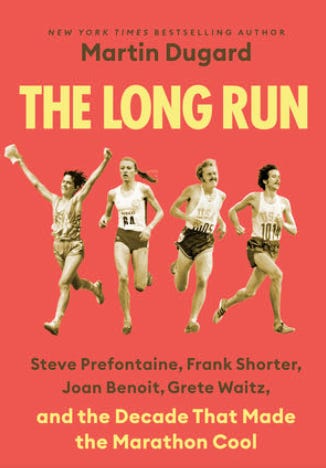
Fortunately, Martin Dugard has written a wonderful account of the indelible period when marathons were magical and distance running was at its peak. In “The Long Run,” Dugard makes a compelling argument that what is often referred to as a single boom was actually a series of interconnected shock waves. Each of those seminal moments helped define the nascent culture of elite distance running while bringing the everyday experience of going for a run directly to the mainstream population.
How can you ascribe the immense popularity of running to a single event when doing so casts aside figures like Rodgers, a charming eccentric who won the 1975 Boston Marathon wearing a crooked bib, a homemade headband, and a pair of lucky cotton gloves. Boston Billy would go on to dominate his home race, as well as the New York Marathon where he would earn even greater fame.
What about Joanie? The Maine dynamo who stormed down Boylston St. in a Bowdoin racing top and a backward Red Sox cap to take Boston in 1979. I wasn’t alive for Shorter’s triumph, and I can’t say I was paying much attention to distance running in ‘79. But I remember every moment of Benoit’s victory at the 1984 Los Angeles Olympics like it was yesterday. How about her great rival, Greta Waitz? Together, the two did as much to revolutionize women’s running as Shorter did for men.
And if we are to assign all of the credit to Shorter, what are we to do with Prefontaine whose audacious racing style was matched only by his rock star persona. Very rarely do athletes in any sport come along with the combination of style and substance that Pre possessed. While actual rock stars tend to die at 27, Pre passed at just 24 years old. Who knows where running would have gone had he lived?
Dugard has stories about all these figures and many more who brought running into the mainstream, thus normalizing the activity for millions (billions?) of runners throughout the world. As Dugard reminds us, it wasn’t so long ago when running wasn’t viewed as good for your health. My favorite quote from the book comes not from Pre or Rodgers, but from Dr. Henry Schroeder who wrote:
“Exercise of a more strenuous nature should be approached with caution, especially in older individuals who will not admit they are subject to the aging process.”
Guilty as charged, Doc.
Reading “The Long Run” is like pulling up a chair in a cozy bar on a rainy afternoon with an old friend. (We’re drinking Athletic because alcohol was getting in the way of our running.) You’ve heard some of these stories before, but not in this much detail, and not with the wit and care that Dugard brings to the task.
In this day and age, taking time to read a book occupies the same type of space as going out for a jog meant in the 60s. They are both simple acts that anyone can do, and a radically subversive counter to conventional wisdom. Who would willingly go out for a run has been replaced by: Who has time to read?
Do yourself a favor and make time for both. Go for a run and then go read a book. Start with “The Long Run.” It’s well worth your time.